You
01 Redo the pricing page, in French and English, without touching the design.
You describe
A goal, constraints, what matters. The Team Leader asks for whatever is missing.

https://console.agents-deck.com/mcp
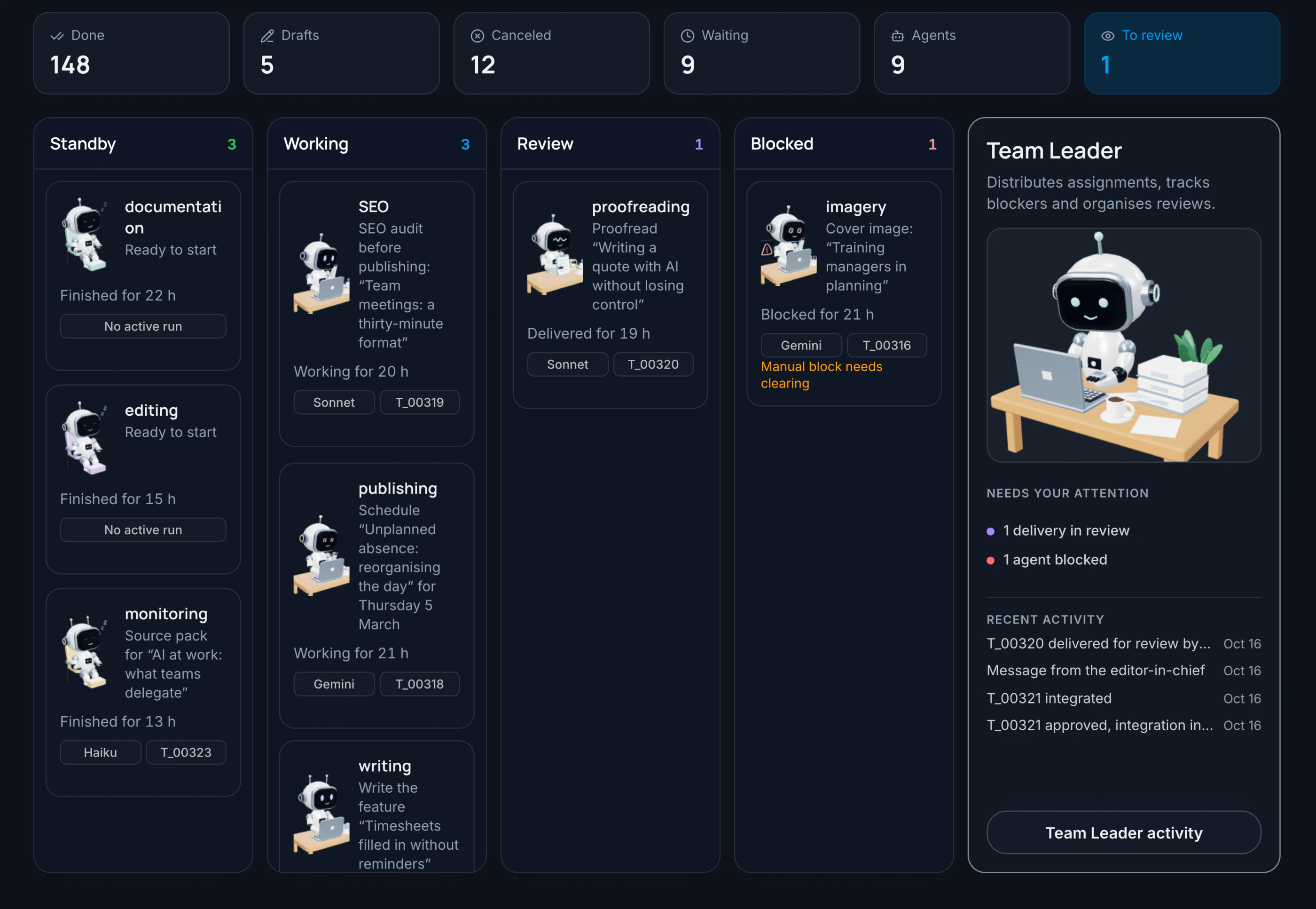
Your AI agents get a role, rules and a lead who reviews everything. You keep the final say.
The trap
With Agents Deck
01Stacking up agents
Every agent has a job description and a lead who reviews its work.
02Letting an agent approve its own work
Here, someone else always reviews: the Team Leader, then you.
03Asking one assistant for everything
One agent per role, with a clear scope. It only touches what it is given.
04Defaulting to the biggest model
The right model is the cheapest one that gets the job done. Moving to a pricier one needs your approval.
People who use AI
Minutes lost per day
Re-explaining, copying, double-checking
Cost of one hour of work
Fully loaded
Minutes lost per day
Re-explaining, copying, double-checking
Your day rate
What you bill per day
Every year, without Agents Deck, you lose in useful time
55 000 €
Per year incl. VAT, yearly plan. AI usage excluded, already paid in your subscriptions.
Redo the pricing page, in French and English, without touching the design.
A goal, constraints, what matters. The Team Leader asks for whatever is missing.
It breaks the work into scoped tickets, picks the agent and sets verifiable acceptance criteria.
Each agent works on its own branch of your Git. The Team Leader reviews, asks for changes or merges.
Work comes back in a heap
Work comes back sorted, reviewed and traced
Memory ends with the session
Every decision stays in its ticket
Everyone works in their corner
A team, with a lead
Costs show up at the end of the month
Costs are tracked ticket by ticket
You write the request, and you accept the result.
A blocked agent does not guess: it asks you, with options.
Moving to a pricier model always needs your approval.
It happened to us
A bug shows up in a feature shipped a month earlier. Thanks to the ticket history, the Team Leader finds the delivery at fault and fixes it at the source.
5 minwith the history
½ daywithout the history
For every team, you see what AI actually delivers and what it costs.
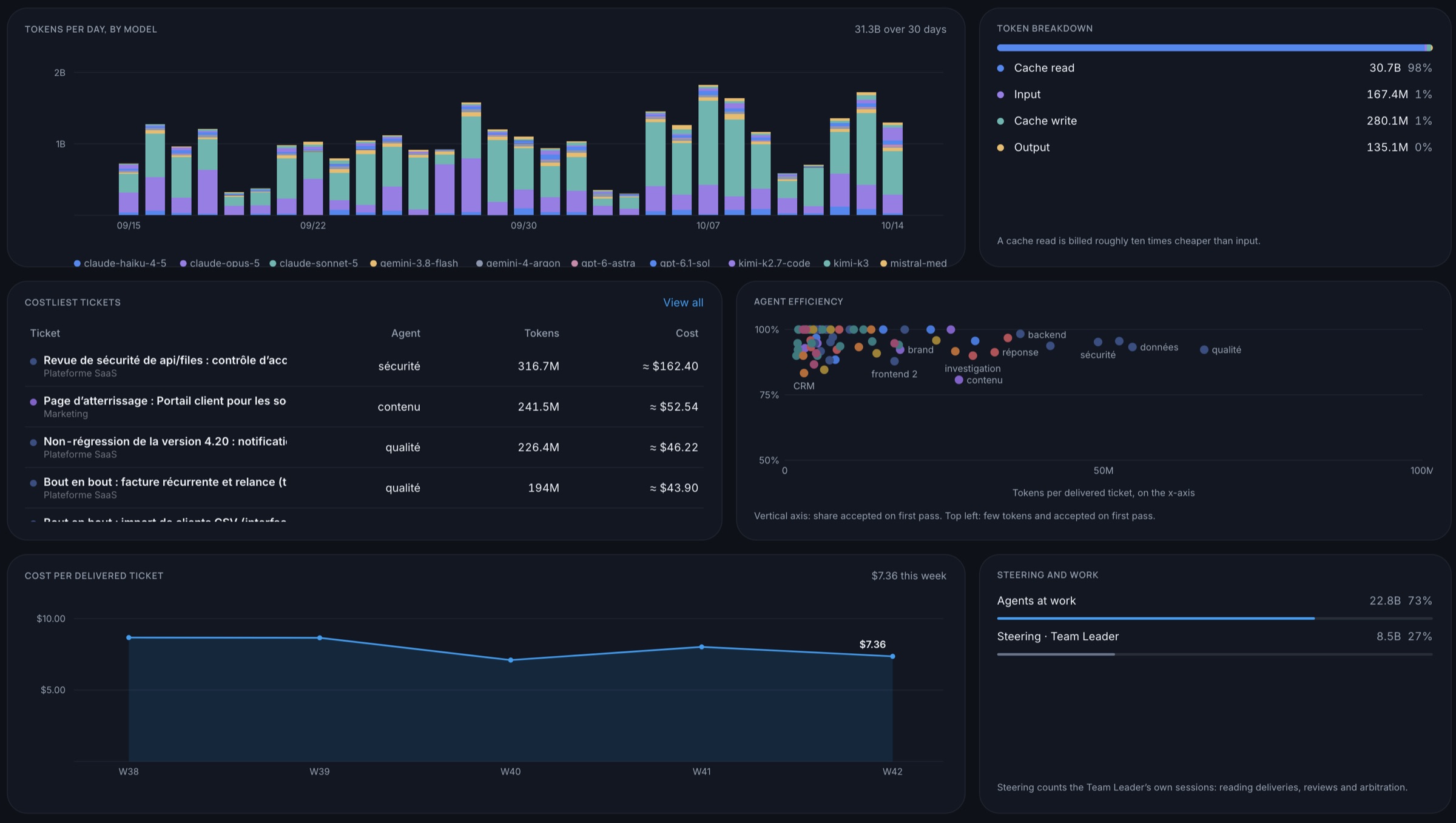
Connect Claude, ChatGPT or Mistral to your Agents Deck projects. Ask where a ticket stands, what is blocked, what shipped this week.
What is blocked this week on the website project?
One ticket has been waiting for review since yesterday, and one agent reports a criterion it cannot check. Everything else is moving.
Connect your AIhttps://console.agents-deck.com/mcp
Vetted agents, ready to join your projects: legal, accounting, SEO, development. And an internal library to share your own across the company.

ADby Agents DeckLegend level 5
★ 4.9
480recruitments
93 %first try
LMby Lina M.Master level 4
★ 4.8
212recruitments
91 %first try
IRby Inès R.Master level 4
★ 4.7
96recruitments
88 %first try
NTby Nora T.Expert level 3
★ 4.6
64recruitments
90 %first try
SKby Sami K.Expert level 3
★ 4.8
138recruitments
94 %first try
KBby Karim B.Master level 4
★ 4.9
157recruitments
92 %first try
Only the recipe is shared. Every version is checked before it goes live.
A hire, an accepted delivery, a review: each one earns you points.
Your points raise your level, and every rank unlocks projects, agents and visibility.
Enterprise plan, in preparation: the master key will be able to stay in your own vault, and you will be able to cut off our access at any time.
€39incl. VAT / user / month
For the whole organisation.
VAT included · No commitment, cancel online anytime
Choose Business€19incl. VAT / user / month
For one team.
VAT included · No commitment, cancel online anytime
Choose Pro€0
To try on your own.
A department, a group, specific requirements?
Talk about your pilot teamAgents Deck does not replace them. It gives them a role, rules and a lead. Your teams keep their tools.
Your repositories stay on your machines. What Agents Deck stores is encrypted per organisation, and every access is logged.
They might. Meanwhile, the time lost every day is real. And Agents Deck works with Claude as well as other tools.
The app installs like any other software, no command line. The console is enough to follow the work.
Only if your organisation allows it. Even then, only the agent’s recipe is shared, never your data.